United Arab Emirates

AI on the cameras a UAE site already has

Cameras are not the gap in the Emirates. Walk any warehouse in Jebel Ali, any tower in Business Bay, any shop in a Sharjah industrial area and the cameras are already up, usually Hikvision or Dahua, usually recent. What is missing is anything that watches them. PGAK is software that runs on that existing estate and turns it into something that raises an alert, logs who came through the gate, and answers a question later without anyone scrubbing footage.

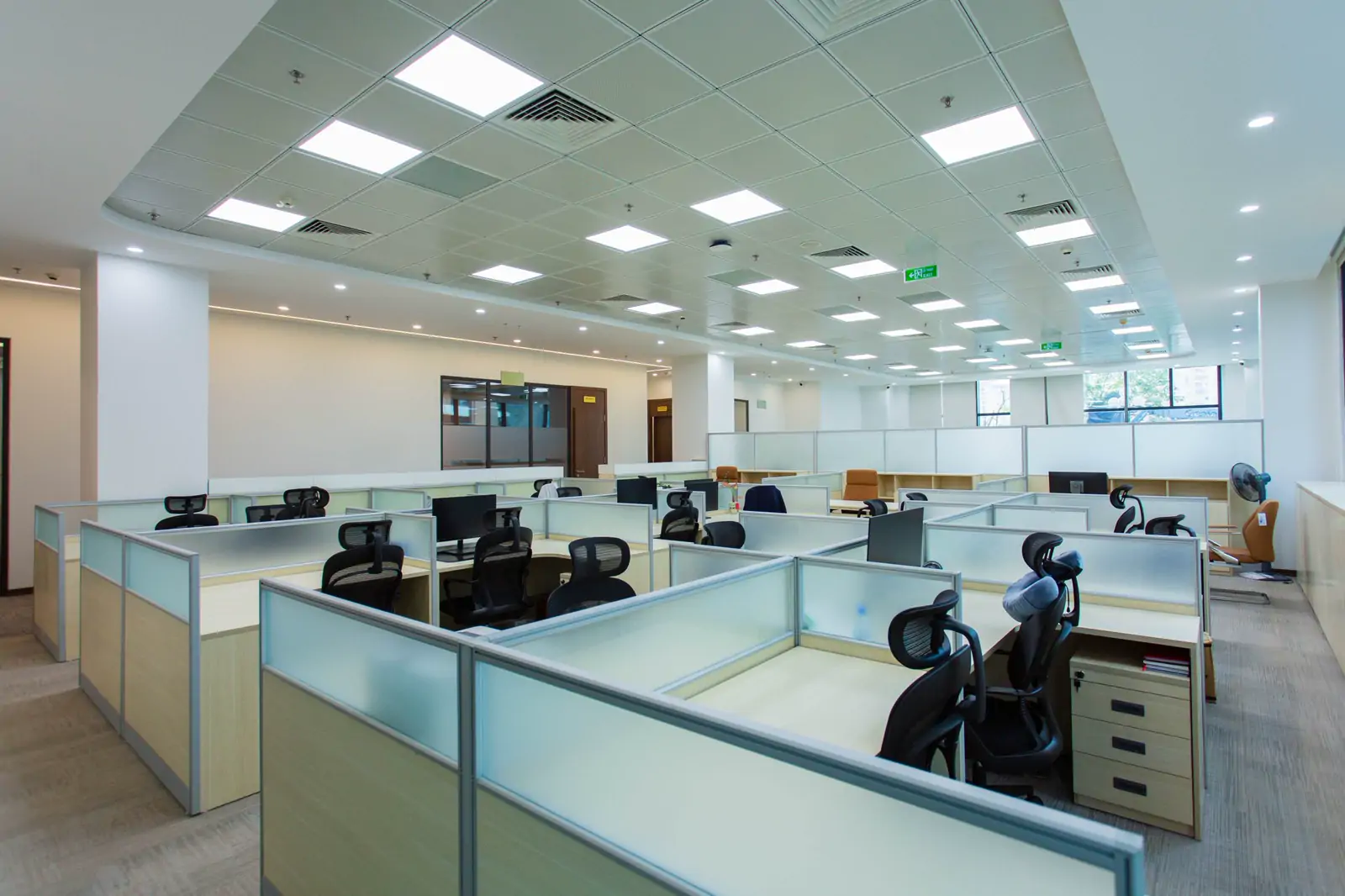
A modern open-plan office floor with cubicles, of the kind that fills a Business Bay or DIFC tower
Stock photo: Doan Thanh Binh / Pexels. Illustrative — not a PGAK site or customer.

Request a camera assessment. Timing and scope agreed on the call. By submitting, you ask PGAK to contact you about this enquiry. Privacy notice.

Treat this page as evaluation guidance. Product availability and site suitability require an approved configuration and technical test. Published scenarios are illustrative, not verified customer results.

Sound familiar?

  • The cameras are good and nobody has looked at the recorder since it was commissioned.
  • Contracted facilities, security and cleaning staff are billed against hours nobody can verify.
  • Four sites across three emirates, four separate apps, no single view.
  • An incident means somebody sitting with a recorder for an afternoon.

The installed base is the opportunity

Search behaviour in the UAE says this plainly: the terms with volume are camera brands and camera prices, not analytics. The market has spent years buying hardware. That is the condition PGAK is built for, because the software is a layer on what is already mounted rather than a reason to re-cable a building. If a site has IP cameras and a recorder, the question is not what to buy — it is whether the existing feeds can carry detection, which is what the free audit answers before anything is quoted.
Contracted workforces and the hours nobody can check

A large share of the labour on a UAE site arrives through an agency, and the invoice is a number of hours the client has no independent record of. Face recognition at the entrance produces that record as a by-product of people coming to work: arrival and departure, by person, in their own group, separate from the headline staff list. It is the same mechanism whether the entrance is a warehouse personnel gate, a tower service lobby or a site hut.

Several sites, one view

Operators here are rarely single-site. A retail group runs across malls in two emirates; a logistics operator runs yards in Jebel Ali and Dubai South; a facilities contractor covers buildings it does not own. Where each site has its own recorder and its own app, nobody sees the estate. Alerts and entry records from every site can land in one place instead, which is usually the first thing that changes when a multi-site operator stops relying on per-site apps.

How PGAK delivers in the UAE

PGAK serves UAE sites remotely, and for software that is the faster arrangement rather than a lesser one. The audit runs on your own feeds within days instead of waiting on a site visit, configuration is done for your cameras, and the fortnight of tuning afterwards is carried out against your real footage in your own working hours. Business here runs in English, so nothing is lost in translation. You give access to the recorder; physical camera work — repositioning a camera, a new cable run — stays with your existing installer, as it would with any software vendor.

Three very different buildings, one estate

An operator here rarely runs one kind of property, and the detections that matter change completely between them. Setting the same rules across all three is the usual reason a system ends up muted.

The Jebel Ali or Dubai South warehouse

A yard, a dock and a personnel gate. The questions are which vehicle came in, whether anything moved in the yard outside operating hours, and which of the contracted crew were actually on shift. Plate logging at the vehicle gate and a line across the yard answer the first two; the personnel gate answers the third.

The Business Bay or DIFC tower floor

No yard and no perimeter — the whole problem is the door and the lift lobby. Here the useful record is who entered outside office hours and whether the cleaning and maintenance contractors attended when the invoice says they did.

The Sharjah or Ajman industrial unit

Older stock, more mixed lighting, and a gate that doubles as the loading point. Detection is more constrained by what the existing cameras captured, which is exactly what the audit measures before anything is promised.

Why one rule set fails all three

A dwell threshold that is sensible on a tower floor produces constant alerts in a working yard. Thresholds are set per position and per site, and the fortnight after go-live is spent settling them against each building's own traffic.

Rows of monitors on desks in an office
Stock photo: Toàn Văn / Pexels. Illustrative — not a PGAK site or customer.

What it will not do

Boundaries worth setting before a trial. Detection is bounded by what the sensor captured, so a camera facing a glare source at noon stays a camera facing a glare source. Retention is the recorder's job and does not change. Access control stays whatever hardware already governs the door. And an alert is information, not intervention — it buys the minutes between something happening and somebody knowing, which is the only thing it promises.

What to check before deployment

Camera and recorder streams
Confirm RTSP access or ONVIF discovery, stream stability and the views that matter. Do not send camera passwords in the enquiry form.
On-site processing
Ask which processing device is needed, how it is sized, what runs locally and what information leaves the site.
Alert acceptance
Test agreed zones in daytime and at night. Record useful alerts, nuisance alerts, missed events and end-to-end alert delay.
Complete commercial quote
Confirm enabled cameras, sites, subscription, setup, hardware, taxes and support. Use the assessed scope to compare proposals.

Get a site-specific AI video analytics price.

AI CCTV software UAE — common questions

Do we have to replace our Hikvision or Dahua cameras?

No, and that is the point. The software runs alongside the cameras and recorder already installed. Whether your specific feeds can carry a given detection is what the free audit establishes, before any commitment.

How do you support a UAE site from outside the country?

Remotely, and in practice that is quicker. The audit, configuration and the tuning period all run against your own feeds, so there is no waiting for an engineer to be scheduled or flown in. Physical camera work stays with your installer. PGAK does not keep an office in the Emirates and does not claim one.

Can one dashboard cover sites in different emirates?

Yes. Alerts and entry records from several sites come into one place regardless of which emirate each one sits in. That is usually the main reason a multi-site operator moves off per-site recorder apps.

Does it work for the contracted staff, not just our own employees?

Yes, and that is normally where it earns its place. Agency and contracted workers can be enrolled in their own group, so their hours are recorded independently of the invoice you receive.

Start with a free audit of your own cameras.

Share your phone number, city and camera count. We will discuss your priority use case and agree the assessment scope, timing and next step with you.

From a working PGAK gate install in India

What the gate operator actually works from

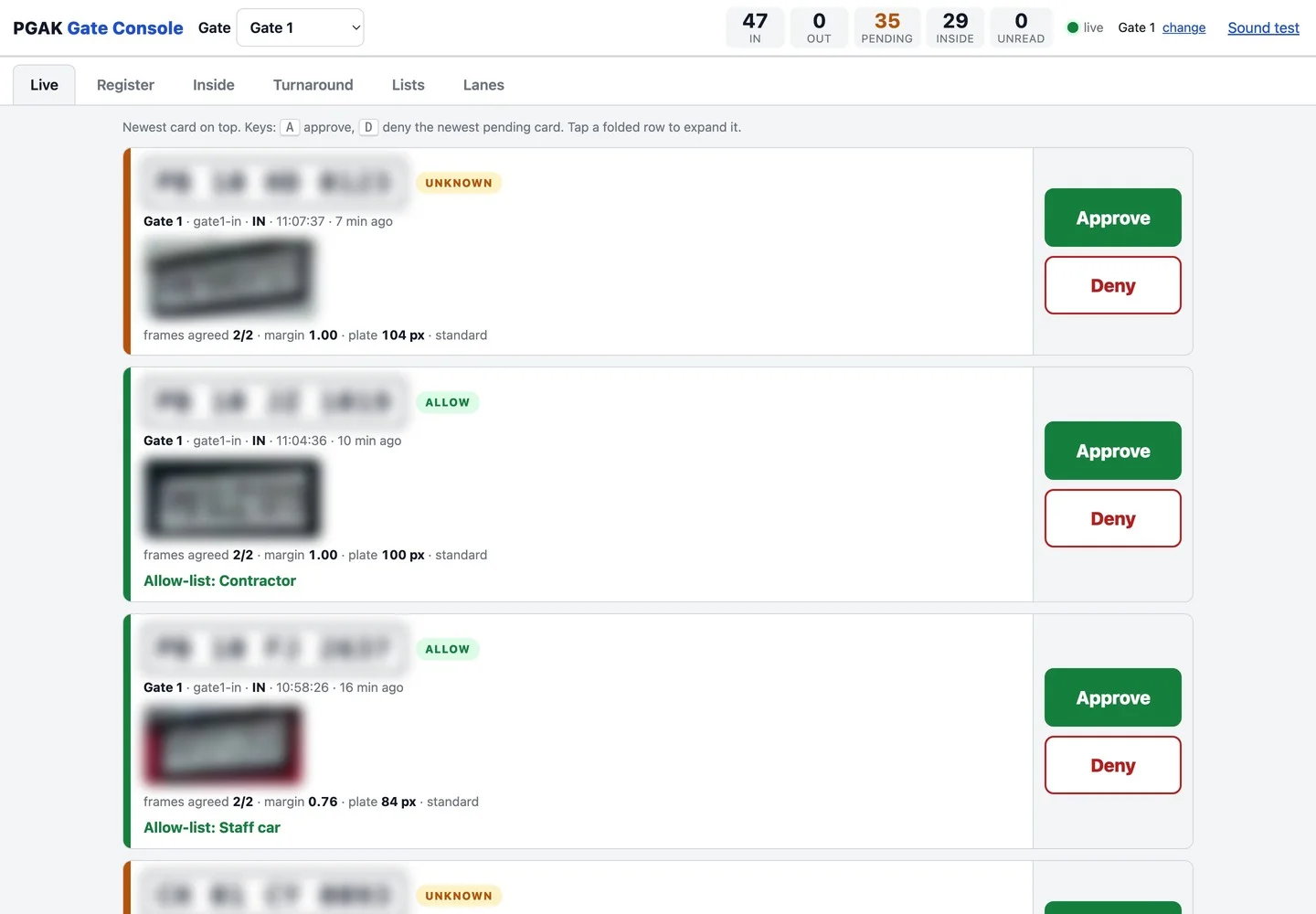
A screenshot from a working PGAK gate installation. It is from a site in India rather than the Emirates — PGAK has no UAE install to photograph yet, and this page is not going to imply one. What it shows is the software a gate operator uses, which is the same software a UAE site would get.

The PGAK gate console listing vehicle reads with approve and deny buttons, allow-list labels and per-read diagnostics, with all number plates blurred
Every read is a decision someone makesThe console a gate operator works from. Each arrival is a card to approve or deny, allow-listed vehicles are marked as staff or contractor, and every read shows its own working — how many frames agreed, the margin, and how many pixels wide the plate was. As shown, each read waits for the operator's decision; any automatic admission is something a site may configure and test, not a default.Number plates are blurred here. A registration number identifies a person, so it is removed before anything is published — including in a screenshot used to sell the product.
Original PGAK photograph.

This is one gate, one camera position and one set of lighting conditions, at a site in India. It is evidence the system has been fitted and operated, not a measurement of how it would read plates at a gate in Dubai or Sharjah — that is tested on your own footage before anything is quoted.

Who you are dealing with

A registered Ludhiana company that builds the software it sells.

PGAK Innovations Pvt. Ltd. is incorporated in Punjab, engineers its own AI layer, and runs the free camera audit itself — the people who answer the phone are the people who built the product. About the company →

Founded
2023, Ludhiana
Registered office
BK Towers, 2480/2, Gill Rd, Ludhiana 141003
CIN
U62013PB2023PTC058631
Talk to us
+91 62839 93600WhatsAppOpen Mon–Sat 09:00-19:00

What a project here involves

Compatible cameras and recorders you already own are reused wherever they are suitable. Detection runs on an on-site processing unit, and camera suitability, stream access, processing hardware and network are all confirmed at the assessment — with anything extra itemised in the quote before you commit.

What the quote is made of

ComponentWhat decides itPrice
Cameras reusedWhich existing cameras give a usable view for each use case — confirmed on a still image of each view.Quoted per site
Cameras moved or addedOnly where a use case needs a view no camera has (plates and faces usually do). Each one named in the quote.Quoted per site
On-site processing unitDetection runs here, next to the recorder. Model, quantity and warranty depend on camera count and analytics.Quoted per site
Software / licencesWhich analytics on which cameras, the term, and the basis for renewal.Quoted per site
Installation and configurationStream setup, zones, schedules, alert routing and commissioning.Quoted per site
PilotAgreed scenes, acceptance criteria and duration before rollout.Quoted per site
SupportHours, response versus fix time, and who replaces failed hardware.Quoted per site
TaxesStated separately on the quote.Quoted per site

How it is evaluated

  1. 1. Self-check — Two minutes, nothing sent — find likely blockers.
  2. 2. Scope on paper — Cameras, use cases and acceptance tests, written down.
  3. 3. Site assessment — PGAK checks streams, views and network on your cameras.
  4. 4. Pilot against criteria — Precision, recall, false alerts and delay, agreed in advance.
  5. 5. Written proposal — Itemised as above; you decide whether to roll out.

Evidence for this page

No PGAK recording is published for this page yet. The capability register shows what has been demonstrated and under what conditions.

Discuss your camera setup

Share your phone number, city and camera count. We will clarify the intended use case and agree assessment scope and timing with you. Do not submit camera credentials or footage.

Request a camera assessment. Timing and scope agreed on the call. By submitting, you ask PGAK to contact you about this enquiry. Privacy notice.