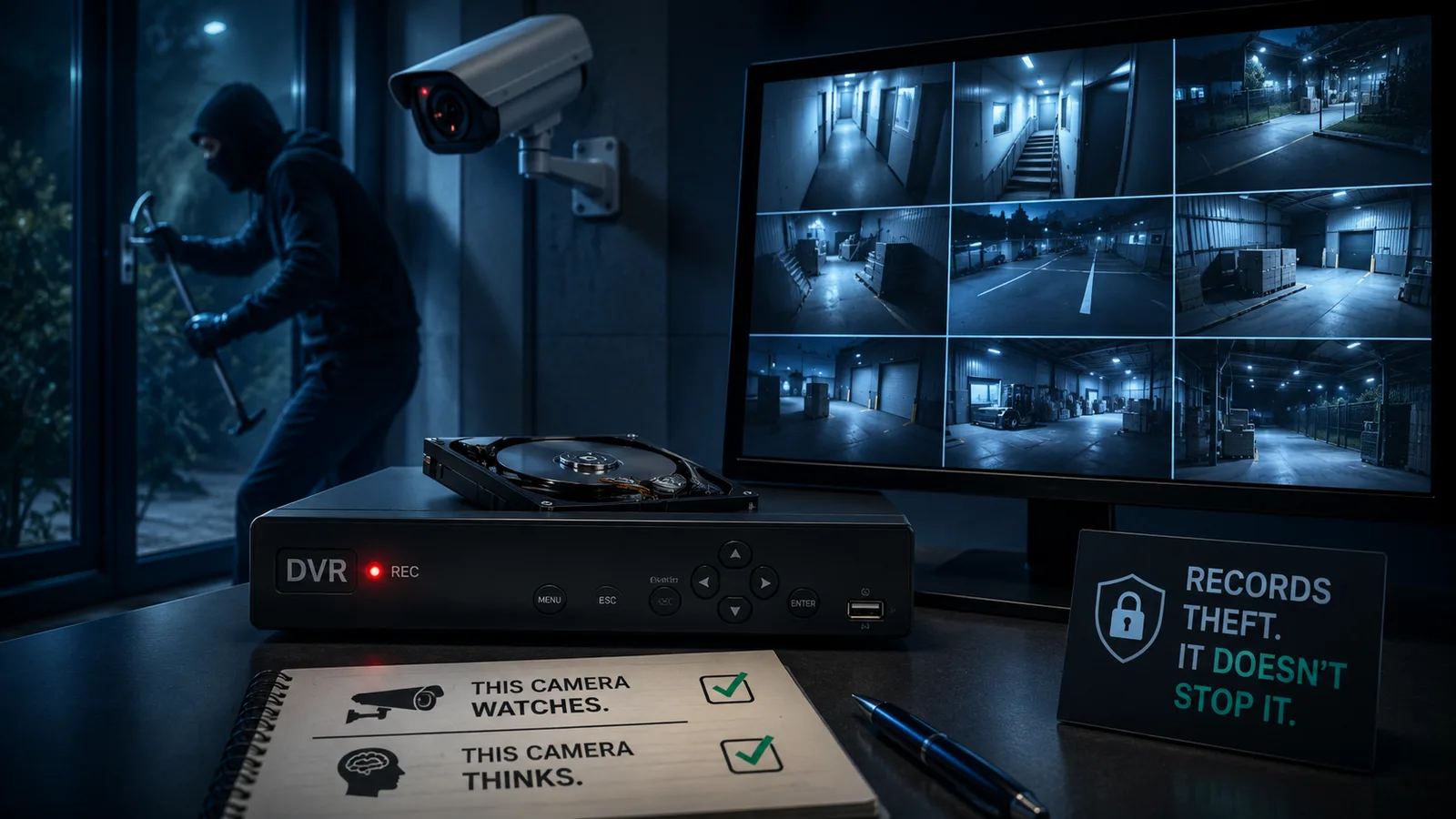
Walk into almost any shop, factory or home in India and you'll find the same setup: four to sixteen cameras, a DVR blinking in a corner, and a monitor nobody looks at.
Ask the owner why they installed it and the answer is always the same — "suraksha ke liye". For security.
But here's the uncomfortable question: what does that system actually do when someone climbs your wall at 2 a.m.?
It records. That's all.
A traditional CCTV system has one job: write video to a hard disk. It does this whether the frame shows an empty corridor, your own staff, or a stranger walking out with your inventory.
It doesn't know the difference. It can't.
So the "security" you bought works like this:
- The incident happens.
- You discover the loss — hours or days later.
- You scrub through footage, hoping the right camera caught it.
- You show the clip to the police, your insurer, your family.
Notice what's missing? Nothing in that chain prevented anything. The DVR gave you a recording of your loss, not protection from it. That's an evidence machine — useful, but it's not what most people think they paid for.
The moment that matters is before
Almost every incident has a window — the stranger loitering near the gate, the person testing the door, the vehicle idling where it shouldn't be. It's usually seconds to a few minutes long.
If someone alerts you inside that window, you can act: turn on lights, sound a hooter, call the guard, call the neighbours, call the police. If nobody does, the window closes and all that's left is evidence.
Traditional CCTV sleeps through that window. A human can't watch 16 feeds around the clock — and honestly, neither can a guard. Attention fades after minutes, not hours.
What "intelligent" actually means
An intelligent layer on top of your cameras changes the sequence. Instead of record → discover → regret, it works like this:
- It watches every feed, every second — software doesn't get bored at 3 a.m.
- It understands what it sees — a person, not a shadow; a stranger, not your son coming home late; someone crossing your boundary, not a dog on the road.
- It tells you immediately — a notification on your phone with a snapshot, while the window to act is still open.
That last part is the whole point. The value of a camera isn't the footage it stores — it's the seconds it can buy you when something is genuinely wrong.
You don't need new cameras for this
Here's what surprises most owners: the cameras you already have are usually good enough. They see everything. What's missing is the thinking — and thinking is software.
PGAK adds that layer on top of your existing CCTV, IP cameras and DVR/NVR, using an on-site processing unit. Compatible cameras are not replaced; what the site needs is confirmed at the assessment and itemised in the quote. Your cameras keep recording as before; they just stop being silent about what they see.
Your cameras can already see. The question is whether anything is paying attention.
Want to know what your current setup can and can't do? Get a free AI readiness audit — we analyse your existing feeds and tell you honestly.