
Colombia

AI CCTV software for sites in Colombia

Colombia concentrates its commercial activity into a handful of very distinct cities rather than spreading it evenly, and each of them produces a different version of the same problem. Bogotá is corporate and logistics-heavy; Medellín has built a genuine technology and manufacturing identity; Cali and Barranquilla sit on different trade routes again. What they share is an installed camera base that records faithfully and raises nothing.

An overhead view of people working at rows of desks
Stock photo: Ron Lach / Pexels. Illustrative — not a PGAK site or customer.

Request a camera assessment. Timing and scope agreed on the call. By submitting, you ask PGAK to contact you about this enquiry. Privacy notice.

Treat this page as evaluation guidance. Product availability and site suitability require an approved configuration and technical test. Published scenarios are illustrative, not verified customer results.

Sound familiar?

  • Cameras in every unit and no one watching any of them live.
  • Entry records kept in a notebook at a gate nobody audits.
  • Several premises in different cities, each with its own recorder.
  • Incidents reconstructed days later from footage, if it is still there.

A few cities, each with its own problem

Because activity concentrates rather than spreads, an operator here is usually in two or three cities at most, and those cities are genuinely unalike. A Bogotá distribution centre is a dock and a vehicle gate problem. A Medellín plant is a shift and boundary problem. Treating them as one estate with one set of alert rules is the usual mistake; the detections are set per site, against each site's own footage and its own working hours.
The gate record nobody can audit

Where entry is written down, the record exists only in the sense that paper exists. It cannot be searched, it is filled in by the person least able to refuse someone, and it is uncheckable afterwards. Face and plate recognition at the entrance replaces it with something timestamped and searchable, which usually changes the conversation about contracted staff and deliveries more than any alert does.

Running it from outside Colombia

PGAK is based in India with no presence in Colombia, and this page will not imply otherwise. The reason that is workable is that the deployment does not need local hands: the audit reads your feeds, configuration is remote, and tuning runs against your own footage over the following fortnight. What does need someone local is physical camera work, and that stays with your installer.

Serving Colombian sites remotely

Distance is not the obstacle it looks like. The audit, the per-site configuration and the fortnight of tuning all run against your own footage, so a Bogotá distribution centre and a Medellín plant can be brought up in the same week without anyone travelling between them. The interface is in English, which fits corporate and multinational teams; a site operating wholly in Spanish should weigh that, and the questions below say so directly.

Bogotá, Medellín and the coast want different things

Colombia concentrates commercial activity into a few cities that are genuinely unalike, and the detections worth running differ enough that treating them as one estate is the common mistake.

Bogotá: docks, vehicles and volume

The capital's distribution estate is a vehicle-gate and dock problem above all. Plate logging and a yard schedule carry most of the value; perimeter alerting matters less inside an industrial park than it does on an isolated site.

Medellín: shifts and the boundary

A manufacturing and technology base with a more settled workforce, where the recurring questions are shift attendance at the personnel gate and movement at the boundary outside working hours.

Cali and Barranquilla: trade routes

Sites oriented around moving goods rather than making them, where who entered and which vehicle carried what is the record that gets asked for, often weeks afterwards.

Why rules are set per site

Detections are configured against each site's own footage and its own working hours. A rule tuned for a Bogotá dock produces noise on a Medellín boundary, and a system producing noise gets ignored within a month.

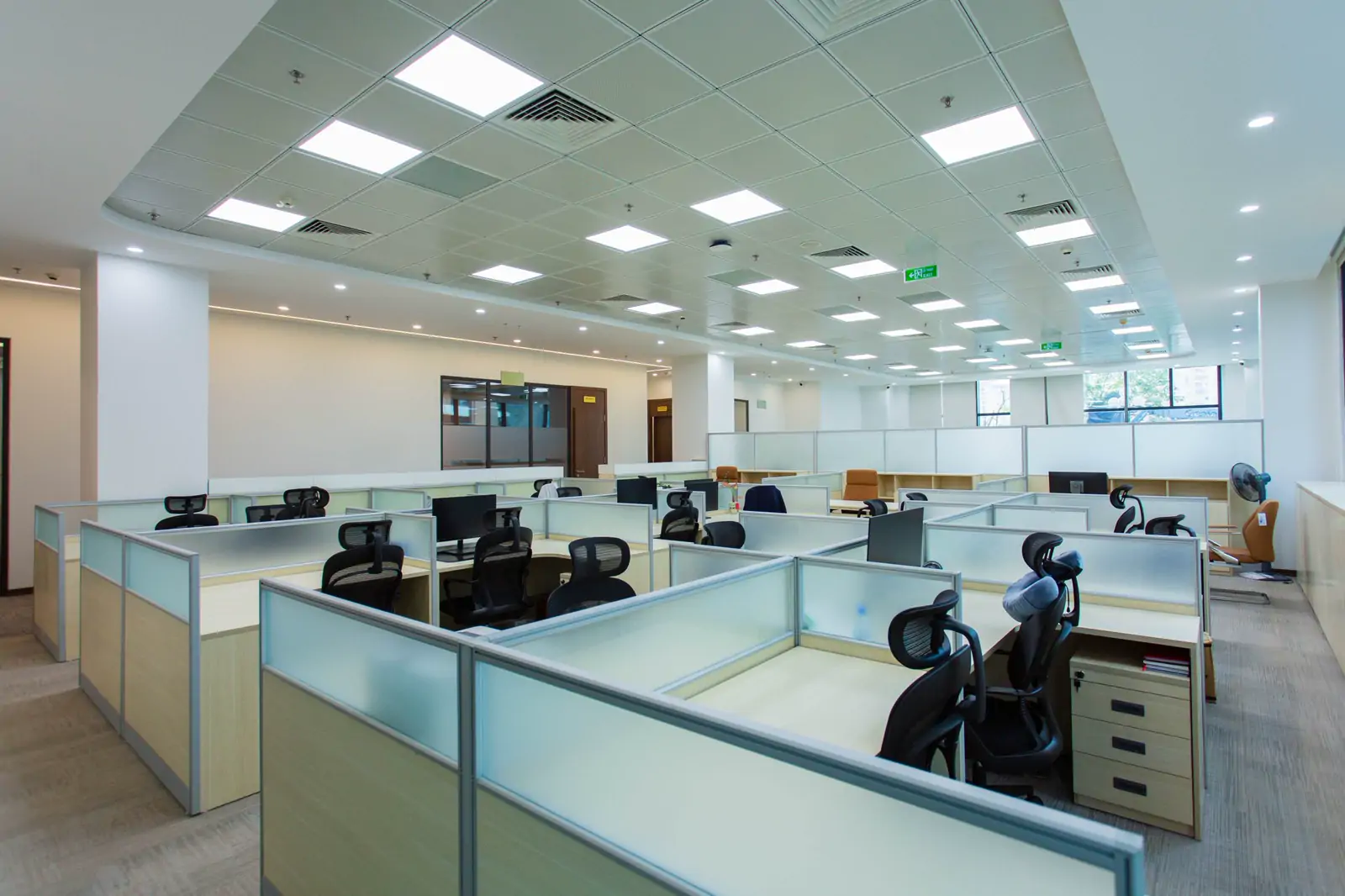
A modern open-plan office floor with cubicles
Stock photo: Doan Thanh Binh / Pexels. Illustrative — not a PGAK site or customer.

Limits

Said once, plainly. What a camera recorded is the ceiling on what can be detected from it, so placement and light are decided before software is. An alert needs the premises online to leave the building. Footage retention stays a property of the recorder you already own. And none of this intervenes — it tells somebody, with a clip, earlier than they would otherwise have found out.

What to check before deployment

Camera and recorder streams
Confirm RTSP access or ONVIF discovery, stream stability and the views that matter. Do not send camera passwords in the enquiry form.
On-site processing
Ask which processing device is needed, how it is sized, what runs locally and what information leaves the site.
Alert acceptance
Test agreed zones in daytime and at night. Record useful alerts, nuisance alerts, missed events and end-to-end alert delay.
Complete commercial quote
Confirm enabled cameras, sites, subscription, setup, hardware, taxes and support. Use the assessed scope to compare proposals.

Get a site-specific AI video analytics price.

AI CCTV software Colombia — common questions

We have sites in Bogotá and Medellín. Can the rules differ per site?

They should. Those two cities produce quite different patterns, and detections are configured per site against that site's own footage and working hours rather than applied as one estate-wide rule.

Can we keep our existing cameras and recorder?

Yes, that is the normal deployment. The audit establishes which detections your current feeds can carry before anything is quoted or changed.

Is anything available in Spanish?

Not currently. The interface and this page are English-only, which suits English-speaking corporate teams and does not suit a site working entirely in Spanish. Worth settling before a trial rather than after.

Who comes to the site?

Nobody from our side. The audit, configuration and tuning are remote. Physical work on the cameras stays with whoever installed them.

Start with a free audit of your own cameras.

Share your phone number, city and camera count. We will discuss your priority use case and agree the assessment scope, timing and next step with you.

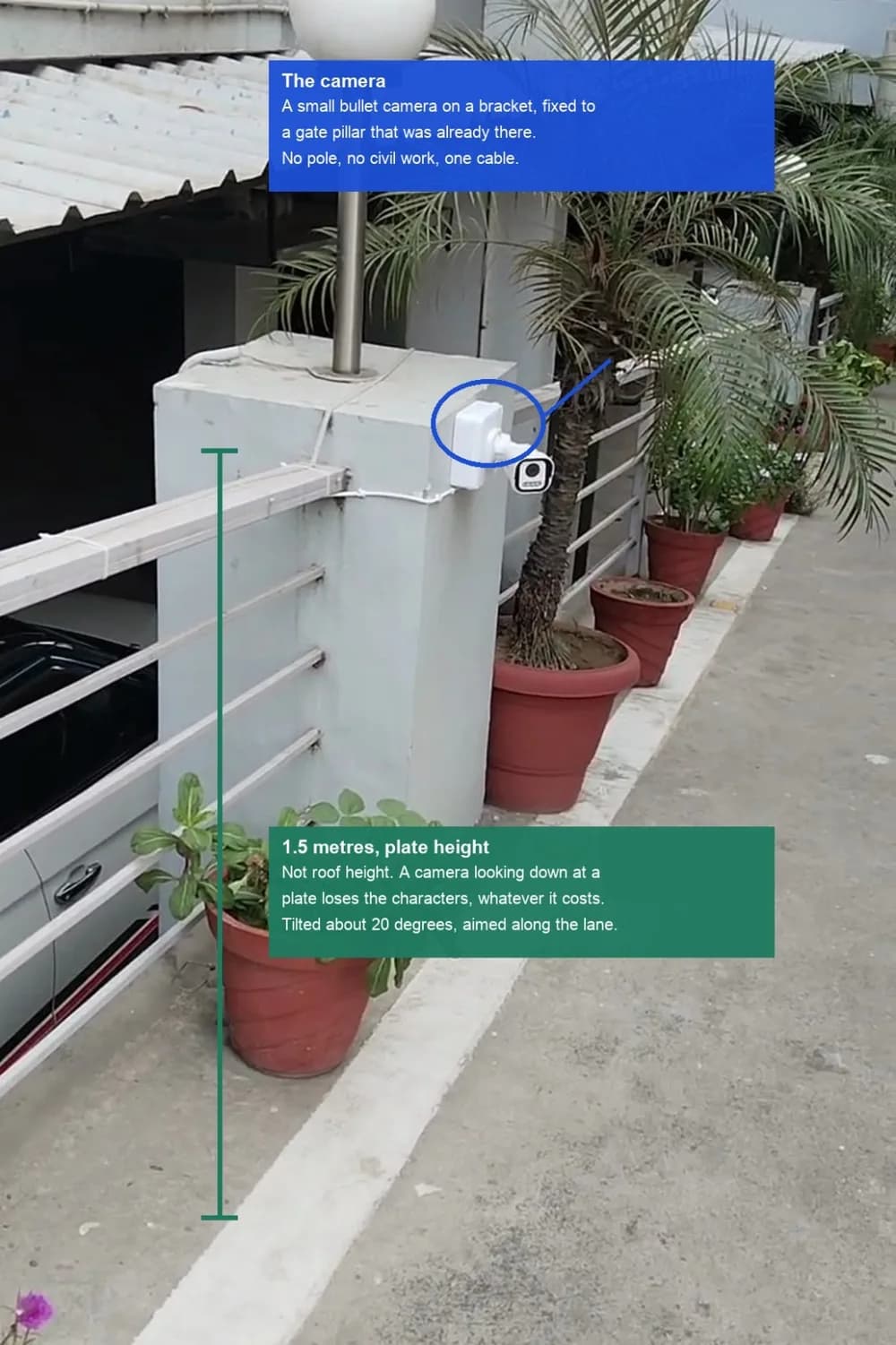
From a working PGAK gate install in India

How the camera actually gets fitted

A photograph from a working PGAK gate installation, at a site in India rather than Colombia. It is here because the most common question from a new market is a practical one: what physically has to happen at the gate.

A small bullet camera on a bracket fixed to an existing gate pillar, mounted at about 1.5 metres and angled along the lane
Mounted on the pillar that was already thereA bullet camera on a bracket fixed to the existing gate pillar — no new pole, no civil work, one cable run. That is the normal shape of a fitting, and it is why a site in Bogotá or Medellín can usually be brought up without rebuilding anything.Conditions: This photograph shows one installation, mounted at about 1.5 metres and aimed along the lane in daylight. The height and angle describe this setup rather than a universal mounting rule. Your camera, capture distance, approach angle, lighting and software need to be assessed together and tested on representative vehicle passages.
Original PGAK photograph.

One gate, one pillar, one lane, photographed in another country. It shows what a fitting looks like, not what your gate needs — the available mounting point, the cable route and the capture view are checked at your own site first.

Who you are dealing with

A registered Ludhiana company that builds the software it sells.

PGAK Innovations Pvt. Ltd. is incorporated in Punjab, engineers its own AI layer, and runs the free camera audit itself — the people who answer the phone are the people who built the product. About the company →

Founded
2023, Ludhiana
Registered office
BK Towers, 2480/2, Gill Rd, Ludhiana 141003
CIN
U62013PB2023PTC058631
Talk to us
+91 62839 93600WhatsAppOpen Mon–Sat 09:00-19:00

What a project here involves

Compatible cameras and recorders you already own are reused wherever they are suitable. Detection runs on an on-site processing unit, and camera suitability, stream access, processing hardware and network are all confirmed at the assessment — with anything extra itemised in the quote before you commit.

What the quote is made of

ComponentWhat decides itPrice
Cameras reusedWhich existing cameras give a usable view for each use case — confirmed on a still image of each view.Quoted per site
Cameras moved or addedOnly where a use case needs a view no camera has (plates and faces usually do). Each one named in the quote.Quoted per site
On-site processing unitDetection runs here, next to the recorder. Model, quantity and warranty depend on camera count and analytics.Quoted per site
Software / licencesWhich analytics on which cameras, the term, and the basis for renewal.Quoted per site
Installation and configurationStream setup, zones, schedules, alert routing and commissioning.Quoted per site
PilotAgreed scenes, acceptance criteria and duration before rollout.Quoted per site
SupportHours, response versus fix time, and who replaces failed hardware.Quoted per site
TaxesStated separately on the quote.Quoted per site

How it is evaluated

  1. 1. Self-check — Two minutes, nothing sent — find likely blockers.
  2. 2. Scope on paper — Cameras, use cases and acceptance tests, written down.
  3. 3. Site assessment — PGAK checks streams, views and network on your cameras.
  4. 4. Pilot against criteria — Precision, recall, false alerts and delay, agreed in advance.
  5. 5. Written proposal — Itemised as above; you decide whether to roll out.

Evidence for this page

No PGAK recording is published for this page yet. The capability register shows what has been demonstrated and under what conditions.

Discuss your camera setup

Share your phone number, city and camera count. We will clarify the intended use case and agree assessment scope and timing with you. Do not submit camera credentials or footage.

Request a camera assessment. Timing and scope agreed on the call. By submitting, you ask PGAK to contact you about this enquiry. Privacy notice.