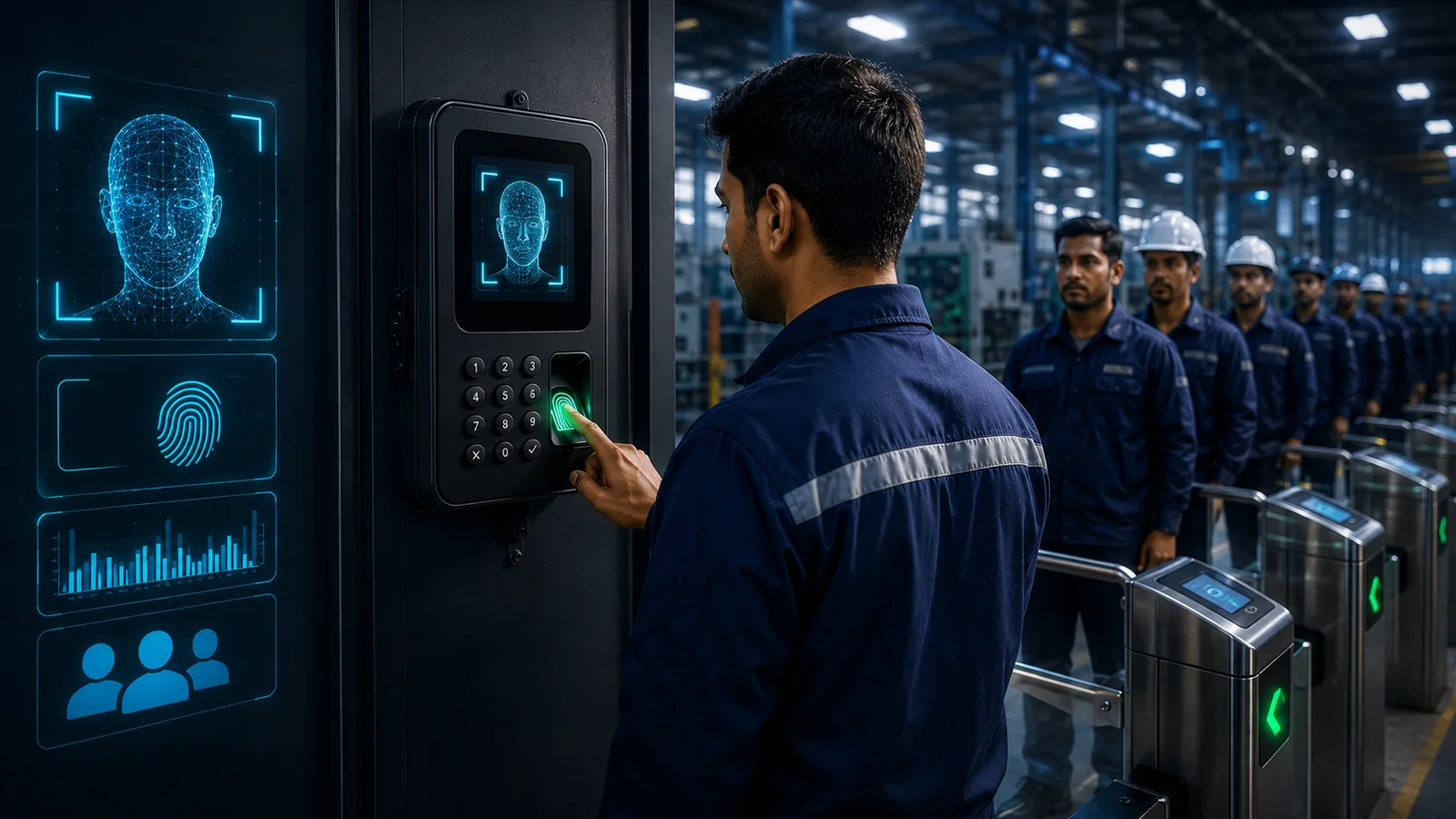
Every factory owner has seen this scene: it's 8:58 a.m., the shift starts at 9:00, and forty workers are queued at a single fingerprint machine. The line moves one beep at a time. Some fingers scan on the first try. Many don't.
The machine was supposed to end attendance headaches. Instead it created a new ritual.
Where fingerprint machines struggle
Biometric machines are fine in an air-conditioned office. A factory gate is a different world:
- Worn and dusty fingers. Grinding, loading, oil, cement — manual work erases fingerprints faster than sensors can read them. The worker tries three times, wipes their hand, tries again. The queue grows.
- Shift-change pileups. One machine, one scan at a time. When 100 people arrive in the same ten minutes, you either buy more machines or accept that "9:00" really means "9:20".
- Gloves, safety gear, wet hands. Anything between skin and sensor means a failed scan.
- The machine itself. It sits at the gate — heat, dust and humidity are not kind to it. When it dies, attendance goes back to the notebook.
- The register still lies. Machines log a scan, not a person's day. Someone scans in, leaves for three hours, comes back — the register shows a full day.
None of this is the manufacturer's fault. It's just the wrong tool for a gate that a hundred people cross at once.
The camera at your gate already sees everyone
Here's the thing: you almost certainly have a camera pointed at that gate already. Every worker who walks in passes through its frame, every single day. No queue, no touching, no scanning ritual — they just walk.
A face recognition attendance system uses that camera as the attendance machine:
- Workers simply walk through. The camera identifies each face as people pass. A hundred people can enter in the time one fingerprint queue clears.
- Nothing to touch, nothing to wear off. Dust, gloves and wet hands don't matter.
- Proxy punching gets hard. A friend can carry your fingerprint card or know your PIN. Carrying your face is harder.
- The same system sees the day, not just the entry. Because it's built on cameras, presence during the shift — not just the 9:00 beep — becomes visible.
- Payroll gets a clean feed. In/out times flow into a register automatically, instead of being typed from a machine export that HR still has to correct.
What it takes to do this well
Honest caveat: not every camera is ready for this on day one. Face recognition needs the face to be seen properly — a camera mounted very high, looking at the tops of heads, won't identify anyone reliably. Usually the fix is small: one well-placed camera at the choke point where people naturally walk through, at closer to face height, with decent light.
That's a one-time adjustment — after which your gate takes attendance by itself, every day, with no queue and no maintenance ritual.
The machine at your gate counts scans. Your camera can count people — by name.
Still weighing the two approaches? Read the honest comparison of face recognition against biometric machines, point by point.
Curious whether your existing gate cameras can handle attendance? The gate this article describes is the one a factory attendance system built for shift change is designed around: no reader to queue at, a photo behind every record, and exceptions a supervisor can actually review. Ask for a free audit of your gate cameras → — we'll analyse your feed and tell you straight.