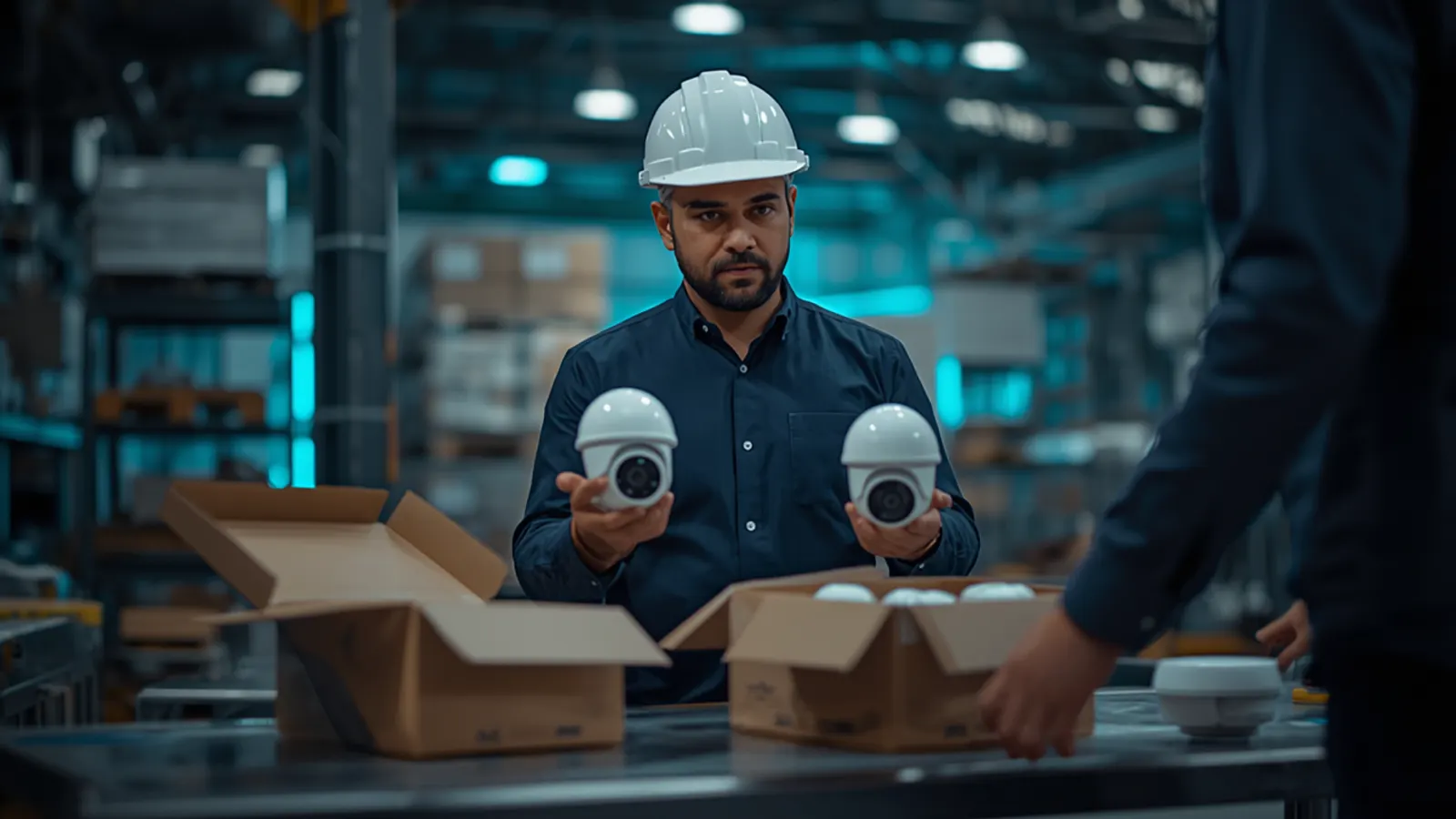
An AI CCTV comparison becomes misleading when a supplier receives the same zero for a failed test and a test that nobody ran. Those are different decisions: one needs an explanation of the observed result; the other needs evidence before a conclusion is possible.
Use a comparison record that keeps requirements, results and gaps separate. A convincing demonstration can help identify what to investigate, but it does not establish performance on your cameras, in your lighting or through your notification path. PGAK supplies AI Alerto and has a commercial interest in this market; apply the same evidence standard to PGAK and every alternative.
Give each supplier the same decision brief
Describe the event you need to detect and the action someone should take. For a warehouse, this could be a person entering a restricted doorway after closing. State the relevant operating conditions, who needs to receive a notification and who will review it. Avoid starting with an unqualified request for “all AI features”.
Include camera and recorder models where known, relevant versions, available streams, the intended view and any existing recording or management software. Mark unknown details for confirmation. Agree a controlled method for sharing any necessary footage; do not put passwords or unrestricted camera links into an ordinary comparison sheet.
Make the proposed scope explicit: demonstration, limited pilot or operational deployment. A laboratory clip, recorded site clip and live site test provide different evidence. Keep their labels visible rather than treating them as interchangeable proof.
Use four evidence states
Define the acceptance criterion before assessing the result. For example, identify the required event, test conditions and notification destination; the supplier and site reviewer must agree any relevant thresholds and review method. There is no universal accuracy or delivery threshold in this guide.
| State | What the record should mean | Decision it supports |
|---|---|---|
| Met in the recorded test | Evidence shows the agreed criterion was met in the documented configuration and conditions | Consider acceptance within that scope |
| Not met in the recorded test | The test ran and an observed result did not meet the criterion | Review the limitation, proposed correction and need for a new test |
| Not run | The required test or part of the workflow was not performed | Request the missing evidence or record an explicit scope decision |
| Incomplete | A test began, but missing conditions, records or review prevent a dependable conclusion | Identify what is missing before assigning a result |
“Outside the quotation” is a commercial scope label, not a technical test result. Record both facts if a required function is excluded and untested. A buyer can choose a narrower scope, but that decision should identify the remaining operational need and its owner.
Do not turn incomplete or not-run items into an accuracy percentage. If suppliers used different events, sample sizes, lighting or camera positions, their result totals may not be comparable. Keep the underlying counts, definitions and conditions available instead of publishing an unexplained combined score.
A hypothetical warehouse comparison
This fictional illustration explains the method. It is not a PGAK customer result, a test of named suppliers or evidence that any product succeeds or fails.
The buyer wants a doorway event assessed at night, followed by a notification to an agreed recipient. Two suppliers present different demonstrations:
| Evidence offered | Defensible conclusion | Next decision |
|---|---|---|
| Supplier A shows a daytime clip with an event box, without demonstrating notification receipt | The displayed clip shows that particular event output. The required night condition and receipt step are not run | Request a test covering the missing conditions and destination |
| Supplier B shows a night event in a local dashboard, but provides no destination record or agreed timing evidence | The local output is observed. The complete notification requirement is incomplete | Identify the missing delivery evidence and reviewer |
Neither demonstration establishes the complete requirement. The buyer should not declare Supplier B the winner merely because the footage is dark, or call Supplier A a failed night test when no night test took place.
If a later agreed test runs and the required event is missed, record “not met” for that test, with its conditions. Retain the original evidence when a supplier changes configuration and retests. The new result can inform a new decision; it should not silently replace the earlier limitation.
Keep the evidence chain readable
Give each requirement a short reference and connect it to one record. Capture the proposed equipment and configuration, the event and conditions, the evidence location, the observation, the reviewer's conclusion and any open action. Identify when the record was created and which revision it concerns.
Separate detection output, notification receipt, human acknowledgement and subsequent action. An event shown on a screen proves neither that a remote recipient received it nor that someone responded. Our camera health and evidence guide separates checks of the live view, playback and alert path; use that detail without adding an unsupported overall “system passed” label.
Technical limits also need context. The AXIS Object Analytics manual describes how scene, lighting, object visibility and configuration affect its analytics. That is a manufacturer-specific example of why conditions matter, not a specification for AI Alerto or a guarantee that another system behaves the same way.
Any proposed interruption or recovery test needs an authorised engineer, an agreed site procedure and an appropriate operating window. A procurement checklist is not an instruction to disconnect a working security system.
Compare the commercial obligations separately
Once technical evidence is understandable, compare what each quote includes. Record hardware, installation, licensed channels or features, recurring fees, storage, network dependencies, integration work, support hours and excluded work. Use the AI CCTV price checklist and ownership-cost worksheet to keep the same scope across offers.
Ask who owns an unresolved problem that crosses camera, network, software and notification services. Distinguish acknowledgement, investigation, attendance and restoration commitments; a statement about one does not establish the others. The AMC scope and repair-closure guide covers maintenance obligations without assuming a universal service package.
Record who can access footage and logs, the agreed retention and export arrangements, and what happens when a licence or service ends. Obtain written answers for the proposed configuration. Do not infer continuity, integration or exit rights from the presence of a familiar camera brand.
Use supplier websites to form questions
Public materials can identify questions for a shortlist. AllGoVision's FAQ discusses camera and software integrations; ask which models and versions apply to your proposal. Videonetics' manufacturing page presents industrial use cases; ask which event and workflow a pilot will actually cover. Vianix describes deployment approaches; ask where processing and data reside in the quoted arrangement.
These are suppliers' descriptions, not independent verification or a ranking. A case study from another installation can provide context, but it cannot replace the evidence needed for your own decision.
Make approval traceable
Keep a short decision note: the scope considered, evidence reviewed, mandatory items met, remaining gaps, accepted limitations and the person responsible for each next action. If a must-have remains untested, state that clearly. A favourable price or an unrelated feature should not erase it.
For AI Alerto by PGAK, discuss your actual site requirement and the proposed configuration through the assessment request. Refer to the capability register and evaluation method when defining what needs demonstration. Agree the evidence and scope before treating a feature description as an accepted result. Installers and dealers can use the separate partner enquiry.
How should I compare AI CCTV suppliers?
Give suppliers the same requirements and ask for evidence tied to the proposed configuration. Separate met, not met, not run and incomplete results, then compare costs, support, data controls and unresolved responsibilities.
Does a missing demonstration mean the system failed?
No. A test that was not run is an evidence gap. An observed result that did not meet an agreed criterion is a failure for that test and its recorded conditions. Neither should be presented as a universal performance claim.
Can a supplier's overall score replace a must-have requirement?
No. Keep mandatory requirements visible and decide how unresolved items affect approval. Extra features or a lower price do not demonstrate that a required function works.