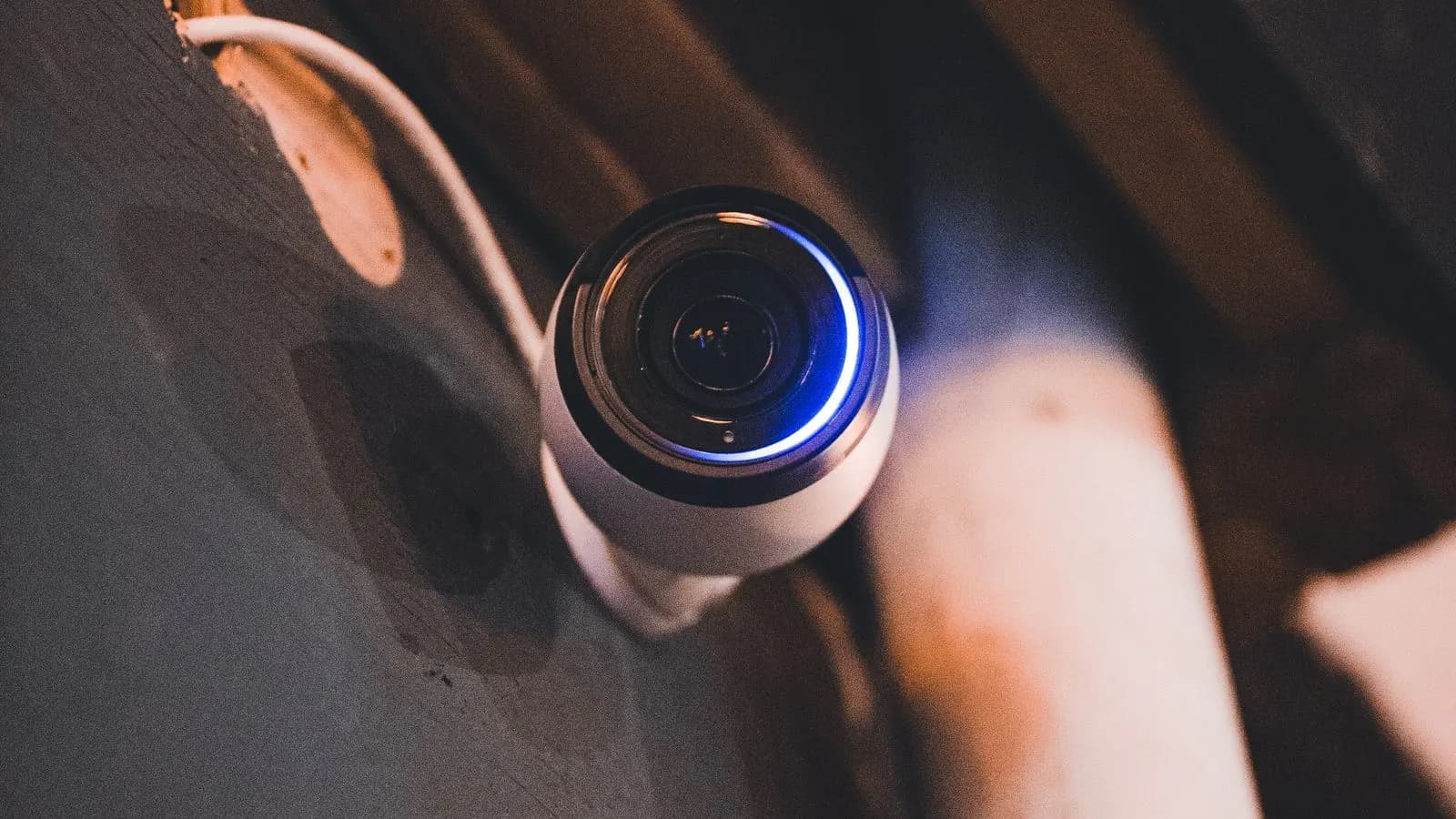
Straight answer: normal CCTV records. AI CCTV watches. The cameras, the cabling and the recorder are usually the same equipment — what gets added is software that understands what is in the frame and tells somebody while it is happening, instead of leaving a file for you to find afterwards. If your CCTV problem is "I always find out too late", that is the gap this closes. If your problem is coverage or lighting, it isn't.
The comparison gets sold badly in both directions, so it is worth being plain about what genuinely differs and what doesn't.
What ordinary CCTV is actually good at
More than people give it credit for, and this matters when you are deciding whether to spend anything.
A working CCTV system deters casual opportunism, settles disputes about what happened, supports an insurance claim and gives police something to work with. Those are real. Most sites we visit already have a competent camera estate doing exactly that, and the cameras are rarely the weak part.
Its limitation is structural rather than technical: it is a record, and a record is consulted after you already know to consult it. Nothing about a DVR is designed to interrupt your evening.
What actually changes with AI
One thing, mainly. Somebody finds out at the time.
Everything else that gets listed on brochures follows from that. The software classifies what is in the frame — a person, a vehicle, a movement across a boundary — and when it sees a thing you said you cared about, it raises an alert then and there.
| Normal CCTV | AI CCTV | |
|---|---|---|
| When you learn about it | When you go looking | While it is happening |
| What triggers an alert | Motion, if configured — pixel change | A classified event: a person in a zone, a boundary crossing, loitering |
| False alarms | Frequent — rain, headlights, insects, shadows | Substantially fewer, because the system classifies rather than reacting to change |
| A camera stops working | Discovered when footage is needed | Flagged automatically, typically within minutes |
| Cameras required | Yours | Usually the same ones |
| Cost shape | Mostly one-off hardware | Mostly recurring software |
That fifth row is the one that surprises people, and it is covered properly in can you add AI to cameras you already own.
The false alarm point deserves its own paragraph
Most DVRs already have "motion detection". Almost nobody leaves it switched on, and the reason is that it works on pixel change. A branch moves, headlights sweep the wall, an insect walks across the lens at night, rain falls — all pixel change, all alerts. After a week of that, everyone mutes the app.
Detection models work differently: they classify what the pixels represent. That lets a system be configured for something specific — a person in the yard after 8pm — and to stay silent for the branch, the cat and the weather.
This is not a minor convenience. An alert stream nobody trusts is functionally the same as no alerts at all, which is the trap we wrote about in 1,000 alerts, only one is real.
What does not change
Worth being equally clear here, because this is where overselling happens.
Your cameras. Usually reused. Same positions, same cabling, same recorder.
Coverage. Software cannot see an area nothing points at. If the loading bay is uncovered, it stays uncovered.
Light. A camera producing a dark smear at night produces a dark smear for the AI too. Lighting is the cheapest upgrade available to most sites and it is consistently the one that gets skipped.
Physical security. Nothing here locks a gate or replaces a guard. What it can do is tell a guard where to walk, which is a different and more useful proposition than replacing them.
The need for someone to act. An alert that arrives on a phone nobody is holding achieves nothing. Deciding who receives alerts, at what hours, and what they do next is part of the deployment — arguably the most important part, and the part most likely to be left undiscussed.
What can it actually be told to watch for?
Concretely, rather than in marketing terms — a person entering a zone you marked as restricted; someone crossing a boundary line; loitering in an area for longer than makes sense; people counted through a doorway or aisle; a camera being covered, moved or blinded; and, where it is set up deliberately and on a consent-based, enrolled-only basis, a face matching someone on your enrolled list.
That last one is how attendance works, and it carries obligations the others don't — we go through them in is AI CCTV legal in India.
Who should not buy this
An honest list, because it saves everyone time:
- Sites whose cameras don't cover what matters. Fix coverage first. It is cheaper and it is a prerequisite.
- Sites with no lighting at night and no intention of adding any.
- Anyone who wants a guarantee that nothing will be stolen. Nobody can sell that. What is on offer is being told promptly, which is a genuine improvement over finding out at 9am, and is not the same as prevention.
- Anyone with nobody to receive the alert. If there is no person and no plan at the other end, the alert is just a notification.
If you recognise your site in that list, the honest recommendation is to spend the money on coverage, lights and a UPS first. Those decisions make everything afterwards work better, whoever you eventually buy from.
How the money compares
Different shape rather than simply bigger. Traditional CCTV is mostly capital: buy cameras and a recorder, own them, replace them in some years. AI analytics is mostly recurring: you are paying for software, updates and tuning, usually per camera per month.
The market range in India is wide — we broke down what drives it in what should AI CCTV actually cost. The comparison worth making is not against your old CCTV bill, which was capital you already spent, but against what the delay is costing you now: the shrinkage you write off, the disputes you cannot settle, the incidents discovered the next morning.
The short version
Normal CCTV gives you the recording. AI CCTV gives you the phone call. If you keep discovering things late, that is the whole product and it is worth the money. If your cameras don't cover the right places or can't see at night, no software fixes that, and anyone telling you otherwise is selling.
Want to know which of your existing cameras could do this without being replaced? Tell us what you've got and we'll go through it honestly, camera by camera.