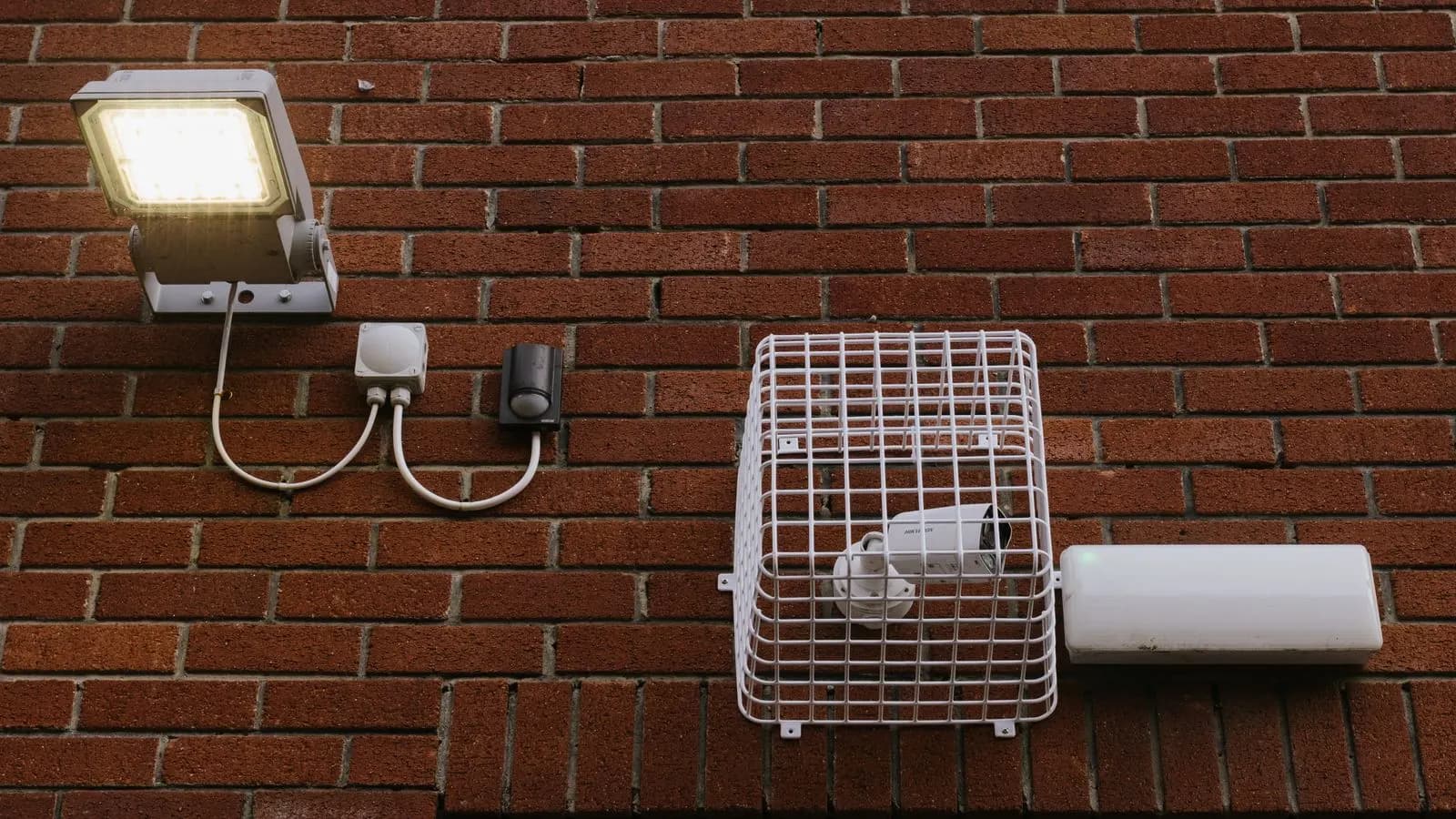
Straight answer: stop counting square feet. Count the ways in and out, the places value concentrates, and the specific events you want to be told about. The camera number falls out of that list. For most Indian factories and warehouses it lands between 12 and 30 — and two buildings of identical size can honestly need double one another, because one has four shutters and the other has one.
The question usually arrives already distorted, because a vendor has quoted a number and the owner is trying to work out whether it is reasonable. It is a hard thing to sanity-check without a method, so here is the one we use.
Why "one camera per X square feet" is a bad rule
It is a rule for selling cameras, not for covering a site.
A 40,000 sq ft warehouse with a single shutter, no yard and stock of uniform low value needs dramatically fewer cameras than a 15,000 sq ft unit with four shutters, an open compound, a despatch desk and a bonded store. Area barely enters into it. What matters is how many places something can happen, and how many places something valuable sits.
Floor-area rules also push you towards wide, high, general-purpose views — which are exactly the views that turn out to be unusable when you need to know who, rather than whether.
The method: work backwards from events
Take a sheet of paper and write down the things you actually want to be told about. Be specific. Not "security" — events.
A realistic list from a manufacturing site:
- Someone in the compound after shift ends
- A shutter opening outside working hours
- Stock going out through despatch that shouldn't be
- A vehicle in the yard that nobody logged
- Somebody in the finished-goods store who has no business there
- A camera going dark
Now for each one, ask: where does this become visible? That location, at the height and angle where the event is legible, is a camera position with a defined job.
Do that honestly and you will end up with a list of positions, each of which you can justify. That is your count. It is also, in our experience, meaningfully lower than the quoted one — and better distributed, because it is built around the ways things actually go wrong rather than around the shape of the building.
A sane starting point by zone
Concrete numbers to argue with, rather than a formula:
| Zone | Cameras | What the camera is for |
|---|---|---|
| Main gate | 1–2 | People in and out; a second at plate height if you want vehicle numbers |
| Each loading bay / shutter | 1 | The bay mouth, angled to see the vehicle and what moves between it and the building |
| Perimeter | 2–6 | Boundary lines, side-on where possible; depends on wall length and blind corners |
| Despatch / returns desk | 1 | The transaction point — where goods and paperwork meet |
| High-value or bonded store | 1–2 | The door, and the aisle inside |
| Production floor | 2–6 | Wide coverage; more for process disputes and safety than for theft |
| Yard / parking | 1–3 | Vehicle movement and after-hours presence |
| Office / cash handling | 1–2 | Where money or documents are handled |
| Server / DVR room | 1 | Because the recorder is a target |
A mid-sized warehouse lands around 12–20. A factory with a compound, multiple shifts and a proper despatch operation lands 20–40. Anything far above that deserves a per-camera justification, and anything far below usually has an uncovered way in.
The principle that saves the most money
One camera, one job.
The single most common failure we see is a camera asked to do two things and doing neither. Mounted high enough to cover the yard, and expected to identify faces at the gate. Angled to watch the aisle, and expected to read plates in the lane behind it.
Those requirements conflict physically — they need different heights, different angles and different fields of view. The result is a camera that produces footage where you can tell a person was present and nothing else.
If a position needs to answer who, it needs its own camera near head height, close to where people pass. If it needs to answer whether, it can be wide and high. Deciding which question each camera answers, before anything is mounted, is the whole discipline — and it is what where to place CCTV cameras so AI detection actually works goes into properly.
Where people under-spend and over-spend
Over-spent, routinely: general coverage of open floor. Six cameras looking at a wide space where nothing much happens, because the plan was drawn from a floor map. Also over-spent: high-resolution cameras on high masts, where the extra pixels are spread across a car park.
Under-spent, routinely: the boring transaction points. The despatch desk. The returns counter. The gate at head height. These are where discrepancies actually originate, and they are unglamorous positions nobody puts on a proposal.
Also under-spent, almost universally: lighting. A camera that cannot see at night is a camera you bought for daytime. Lights are cheaper than cameras and improve every camera already installed. If your budget is fixed, moving money from the last two cameras into lighting is usually the better trade.
What about the watching?
Here is the part that changes the calculation.
Camera count only matters if something is looking at the output. On a wall of twenty-four feeds, human attention degrades within minutes — this is well established and not a criticism of anyone's guards. We wrote about the arithmetic of it in you have 120 cameras, nobody can watch them all.
Which means the honest sequence is: get coverage right, get lighting right, then automate the watching. In that order. A site with 14 well-placed cameras and something reliably watching them is in a considerably better position than a site with 40 cameras recording to a box nobody opens.
That ordering also protects you from the most expensive mistake available, which is buying a large camera estate and discovering afterwards that the positions cannot answer the questions you care about.
The short version
Count entrances, count value, list the events you want to know about, and give every camera one job. The number comes out of that, and you will be able to defend each position — which is more than most quotes can do.
If you want a second opinion on a quote you have been given, or a list of positions for a site you are planning, tell us the site and what you're trying to prevent. We will tell you which cameras we think are unnecessary, which is usually the more useful half of the answer.