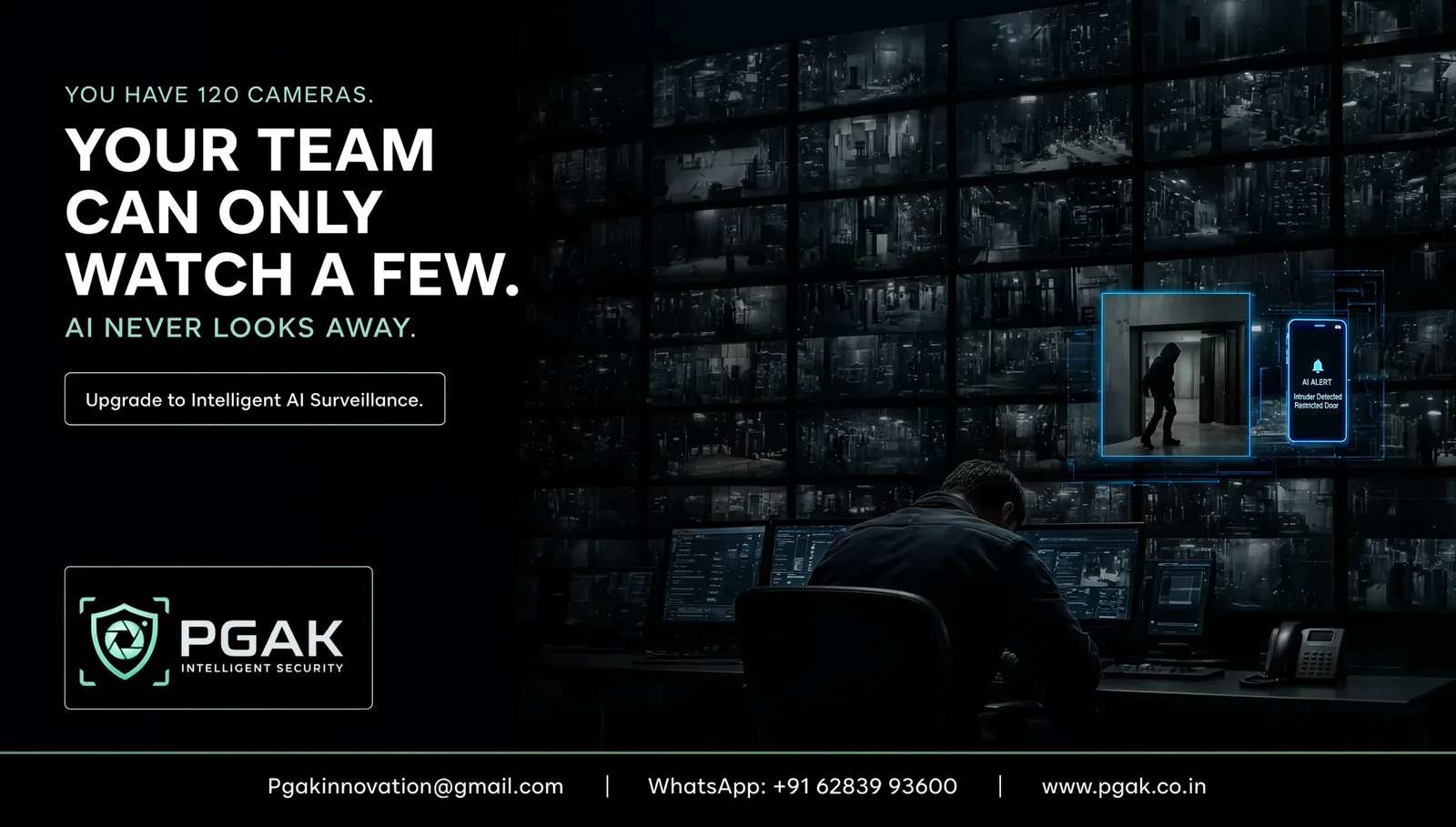
Walk into most large control rooms and the setup looks serious: a wall of monitors, dozens — sometimes over a hundred — camera feeds tiled edge to edge, all live.
Then look at the desk. One guard. Maybe two on a good day. A phone, a cup of tea, and a night that's mostly quiet until, suddenly, it isn't.
The uncomfortable truth is simple: you can have 120 cameras and still not be watching.
The math nobody says out loud
A person can meaningfully watch a few feeds at once — not a hundred. Even a large video wall only shows a fraction of your cameras at a readable size, and the operator's eyes can only rest on one tile at a time.
So at any given moment, the vast majority of your feeds are recording to a disk that no human is looking at. On the night shift, with one person covering everything, it's worse.
Human attention was never built for this
This isn't about lazy guards. It's about biology. Studies of CCTV control rooms have found that after roughly twenty minutes of staring at monitors, an operator misses the large majority of what actually happens on screen. Attention drifts. Nothing moves for hours, and then the one event that matters unfolds on the one tile nobody was watching.
The result is the pattern every site owner knows:
"We have it on camera."
Said after the theft, the break-in, or the unauthorised entry. That's evidence — not protection.
What "AI never looks away" actually means
This is the gap PGAK closes. Instead of asking a tired human to watch 120 feeds, an AI layer watches all of them at once, every second, without blinking:
- It sees every feed simultaneously — no tile is ever "off-screen."
- It only speaks up when something matters — an unknown person, loitering, someone entering a restricted area or crossing a perimeter after hours.
- It pushes a real alert — a notification with a snapshot, in seconds, to the phone of the person who needs it, so someone can act while it's happening.
It turns 120 passive recordings into 120 active sensors. The guard stops hunting through a video wall and starts responding only to events that are genuinely worth their attention.
And it runs on the cameras you already have
You don't rip out the wall of screens or buy 120 new cameras. PGAK layers onto your existing CCTV, IP cameras and DVR/NVR — the intelligence is added on top, so there's no downtime and no fresh hardware spend.
Where to start
You don't have to switch on smart monitoring for every camera on day one. Most sites begin with the feeds that carry the most risk — restricted zones, perimeters and after-hours entrances — and expand from there.
If your team is guarding more cameras than any person could realistically watch, that's exactly the problem intelligent monitoring is built for.