Straight answer: face recognition struggles at badly lit gates because infrared light — the thing that lets a camera "see" at night — is good at showing that someone is there but bad at capturing the facial detail needed to say who. The fix in most cases is not a better camera. It's putting the right kind of light on the right spot.
If your gate camera flags every person walking through at 9 PM but can't match a single one of them to an employee record, this is almost always what's happening.
Why does face recognition fail at night when the camera clearly sees the person?
Two different jobs get confused. Detection — noticing that a human-shaped object is in frame — works fine in the dark because infrared sensors are built for low light. Identification — matching that face against a known person — needs much finer detail: skin tone variation, the contrast between eyebrows and skin, the shadow under the nose. Infrared footage compresses all of that into flat grey tones.
So the camera isn't broken. It's doing detection well and identification badly, because those two tasks need different kinds of light.
Can infrared cameras be used for face recognition?
Only partway. IR floods the scene evenly and reflects off skin in a way that removes the natural contrast a face-matching algorithm relies on. Faces on IR footage tend to look like pale, similar ovals — enough for a human reviewer to confirm "yes, a person walked through," not enough for software to tell two similarly built people apart. This is a real limitation of the physics, not a flaw in any one vendor's algorithm.
What actually fixes this — a new camera or a light?
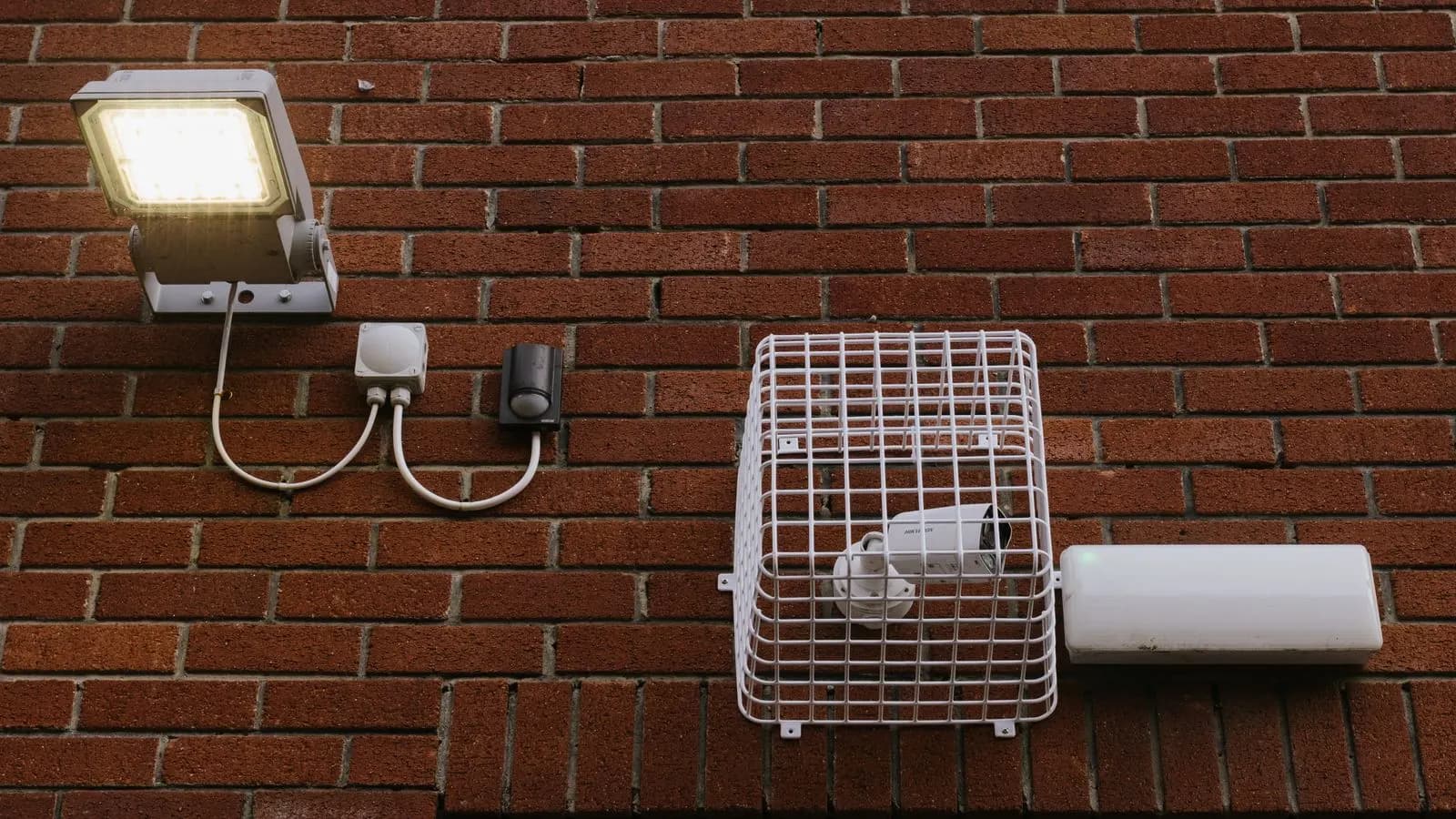
Usually a light. A single warm-white fixture placed to illuminate faces at the point people pass — not the whole yard — restores the contrast infrared throws away, and it typically costs a small fraction of a low-light camera upgrade. We've seen sites spend on a "starlight" or ultra-low-light camera before trying a ₹150 fixture that solved the same problem in an evening.
That doesn't mean cameras never need upgrading — a genuinely underpowered sensor in a very dark tunnel entrance may need one. But check the cheaper fix first.
Where should the light actually go?
Placement matters more than brightness.
- In front of the face, not behind it. A light behind the walking person creates a silhouette — the classic problem of a bright doorway making everyone entering it a black shape.
- Angled down onto the path, not into the lens. A light aimed at the camera itself causes glare and blooms out the detail you're trying to capture.
- At head height, roughly matching the camera's mounting height. A light aimed at the ground lights shoes, not faces.
- Warm white, not raw IR floodlight. IR floodlights help detection but do nothing extra for identification, since the camera is already using infrared at night.
A five-minute test after installing: walk through at the time of day you're fixing for and check whether your own face is recognisable in the review footage, not just present in it.
What won't lighting fix?
Be honest about the limits. Good lighting removes the single biggest cause of night-time misses, but it doesn't fix a camera mounted too high and shooting down at the top of people's heads, someone walking past at an angle rather than facing the camera, or fast-moving crowds during a shift change. Those need camera positioning and enrolment quality fixes, which is a separate problem from lighting.
We build face-recognition attendance software that depends on gates being lit and positioned correctly, so we have a stake in recommending this — but the physics here doesn't change depending on who's selling you a camera. Fix the light first. It's the cheapest test you can run before spending on hardware.